


 Loading...
 Dr. Marcus Borg, Jesus scholar and popular theologian, draws a stark picture of trends affecting modern American Christianity: It is a time of conflict, with a great divide growing between “The Christian Right” and “Progressive Christianity,” and many Christians standing bewildered somewhere in the middle. While the debate rages, more and more Americans, following the pattern set in the last century by our cousins in Europe, are throwing up their hands and leaving Church.
Meanwhile, mainline churches are graying and shrinking, facing the hard possibility that church closings lie in the near future for religious communities whose membership may shrink below the critical mass needed for survival.These trends come as a dramatic and striking change from the “common Christianity” of a generation or two past, when most Christians shared basic beliefs, and when it was assumed that most Americans would be active in their church.*
Will Christianity as we know it survive into the more distant future? Perhaps, Borg says; but it may take a form very different from the church we know.
This is one observer’s take-away from Borg’s three-day visit to St. Matthew’s Episcopal Church Oct. 21-23, which attracted some 300 people from a variety of faith traditions across the region for a lecture, a workshop and a sermon on Sunday. His visit, in St. Matthew’s Dimensions of Faith speaker series, was also supported by Second Presbyterian Church, Highland Baptist Church and the Louisville Presbyterian Seminary. [The lecture series was videotaped and may be found at the parish's Dimensions in Faith video site at //www.stmatt-ky.org/dimensions_of_faith_video.htm]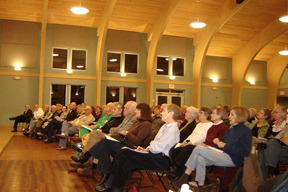
Much of the workshop drew on his most recent book, “Speaking Christian, Why Christian Words Have Lost Their Meaning and Power, and How They Can Be Restored.”
He peppered his speeches with jokes, many of them, in Borg’s inimitable style, just irreverent enough to elicit quiet gasps followed by hearty laughs. He opened his lecture, for example, with an extended joke, lifted from the Internet, about how beer is better than church. (“No one will kill you for not drinking beer,” for instance; and “When you have a beer, you don't knock on strangers' doors trying to give it away.”) Saturday, some of his jokes took on a political edge as he declared that Adam Smith’s “invisible hand” of market economics “has its middle finger raised,” and went on to read a purported letter to the editor from Satan to the Rev. Pat Robertson, in which the Prince of Darkness declared his contract with Mr. Robertson null and void because the televangelist’s acts “are making me look bad.”
Borg’s attention-grabbing program featured much more than jokes and laughs, of course. Judging from the many probing questions and discussions, he had people thinking about Christianity in new ways.
Understanding “righteousness” and “mercy” in their original senses as “compassion” and “justice” gives them a whole new meaning, Borg said. “Think about the division of Christianity shaped by righteousness and mercy and one shaped by compassion and justice. The former detracts from and obscures God’s passion for a transformed world. … Christianity is not primarily about individual righteousness and it's not primarily about our having sinned against God and needing forgiveness. It’s about loving God and changing the world. The Christian Gospel is about transformation - changing ourselves and the world.”
“Marcus Borg brought excitement and hope,” said Lucinda Laird, rector of St. Matthew’s. “He offered us new ways of thinking about concepts and words that we have taken for granted, or struggled with, and pointed the way to a deeper commitment to Christ in both heart and mind.”
*Editor’s note: The latest figures from The Episcopal Church may be found here. Click here for an overview of congregational life from a 2010 survey by The Episcopal Church.