



 Loading...
I want to thank you for opening the cathedral doors! And you have no idea how tempting it was to knock on the doors not with my crozier, but with a Louisville Slugger!
It is a joy to be with you this morning, gathered around the Holy Table to receive the Bread of Life and the Cup of Salvation. Your wonderful liturgical welcome is matched only by the generous hospitality Linda Sue, Tim, Becky, and I have experienced since our arrival last month. Beautiful homes have been opened to us, delicious meals have been provided, and understanding smiles have said, “Welcome, and we know it isn’t easy moving to a new community, into a new high school, finding a home, packing your stuff in Kansas City, and then moving that stuff here” which finally happened one week ago yesterday. Most of all, your prayers have meant, and continue to mean, so much as we join the faith community that is the Diocese of Kentucky, and as I enter a new vocation that may have the steepest learning curve in creation! So please, keep the prayers coming!
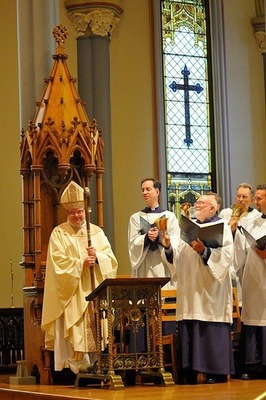
Over the last couple of days word got around that today is my birthday. Indeed, one of the younger members of our diocese at yesterday’s reception asked, “Bishop Terry, is tomorrow really your birthday?” I said, “Yes”, and his eyes got really big. Next he asked excitedly, “What do you think you’ll get?” I replied, “I’m getting a new chair!” He countered, “Is it a recliner?” Well, Mr. Dean??
My thanks to Dean Mark, Canon Amy, Canon Robert, Tom, P’tricia and Chris, and so many of you who have worked tirelessly to make this weekend a celebration for the diocesan community and out-of-town guests.
Seeing so many who have blessed me and formed me through the years, means a great deal. Some have traveled great distances, and the turnout from Trinity Church, Highland Park, IL, and Grace and Holy Trinity Cathedral in Kansas City has been amazing. My god-daughter is here, and so are two great friends who endured seminary with me and who served with me int eh diocese of Fond du Lac years ago. There is a gracious meal following this liturgy provided by the people of Christ Church Cathedral, continuing the Anglican cathedral-style hospitality I have known these last 6 years. I hope our old friends will meet our new friends during that meal. I am most anxious for you to get to know each other. And the Kansas City Cathedral staff would love to tell you stories about me, though the priests will expect a donation to the discretionary fund!
Beloved - old and new friends, fellow proclaimers of the Gospel and bearers of the Anglican tradition - let us now engage the Word.
On October 1, Columbia Pictures will release The Social Network, a film that portrays Facebook's CEO and cofounder, Mark Zuckerberg, as an arrogant nerd-punk who betrays friends and classmates in order to get what he wants – sex, money, and power.
The movie is fiction. So is the book it's based on – Ben Mezrich's The Accidental Billionaires.
Facebook hates the movie. Zuckerberg says he will not watch it. Based on the early reviews of the movie, this makes sense.
According to sources – sources who despise Mark Zuckerberg and sources who admire him – the only reason The Accidental Billionaires exists is because one of Mark's Facebook cofounders pitched the book in an attempt to permanently damage Mark's reputation. According to those sources, that cofounder and Harvard student is Eduardo Saverin.
Now it so happens that a few days ago Forbes Magazine released its current list of the 400 richest people, and in the ten top richest Americans are both Mark Zuckerberg and Eduardo Saverin. The article goes on to suggest that some of the richest people made huge strides in 2009, with the total worth of the list up 8%, far exceeding the 1% growth of the S&P 500, indicative of the level of economic recovery most Americans have experienced. Quite a gap. The article does not report on whether charitable giving by those on the list increased by the same percentage or greater.
Now lest any of us are tempted to point a judgmental finger at Zuckerberg, Saverin, or anyone on the richest list, I encourage us all to visit the website of www.globalrichlist.com There you can type in your annual income and see where you rank in the world. It is quite humbling. For instance, if your income is at least $33,750, you are in the top 5% of the wealthiest people in the world. At $47,500, you are in the top 1%.
Today we hear Jesus telling a parable about a rich man, and on this day, imagine my joy to read this is a rich man dressed in purple. This parable is particular to Luke, and seems to further illustrate the promised work of God sung in the first chapter of Luke: He has cast down the mighty from their thrones, and has lifted up the lowly. He has filled the hungry with the good things, and the rich he has sent away empty.
Again, before we rejoice that someone else is about to get theirs, we must face the truth that relative to the world’s population, we are unimaginably rich, and God has very clear ideas about what the rich are to do with our abundance of money.
Further, this parable must not be limited to the practice of individuals, but applies to the Church as well. Are we adding to the width of the chasm, or are we bridging the divide? What needs, what people in need, are at our own gates that we do not see? And what needs do we see but choose not respond to, because other things get our attention first? The Lord Jesus calls us each and all as his Body, the Church, to see each Lazarus, to seek out Lazarus, and serve Lazarus as we would serve Christ himself.
The Gospel for today, and our baptismal covenant, demands the Church live into radical servanthood. Especially those dressed in purple.
On this occasion I searched for some purple wisdom, particular thoughts on servanthood shared by bishops. Two stood out. Dom Helder Camera, Roman Catholic Archbishop of Olinda and Recife, said, “When I gave food to the poor, they called me a saint. When I asked why the poor were hungry, they called me a communist.” Jesus calls us to not only fill the hungry with good things, but to lift up the lowly as well.
Archbishop Desmond Tutu, making a clear reference to Lazarus being content with the crumbs beneath the rich man’s table said,
“I am not interested in picking up crumbs of compassion thrown from the table of someone who considers himself my master. I want the full menu of rights.”
And in another context he wrote: “If you are neutral in situations of injustice, you have chosen the side of the oppressor. If an elephant has its foot on the tail of a mouse and you say that you are neutral, the mouse will not appreciate your neutrality.”
As we become more effective servants, the Church itself reaps a great benefit. Being a servant community is powerfully effective evangelism. People are drawn to congregations engaged in mission, who care for their neighbors, who take the new commandment to love one another seriously.
Recently Canon Amy and Father Matt Bradley pointed me toward the results of a survey conducted by members the Barna Group for their book, unChristian. The survey learned that the three most common phrases un-Churched people between the ages of 16-29 associated with present-day Christianity were anti-homosexual (91%), judgmental (87%), and hypocritical (85%).
Only 55% of that same survey demographic described Christianity as "a faith you respect".
This shift in perception is, for the most part, recent and rapid. A study by the same group conducted in 1996 found that 85% of respondents in the 16-29 demographic were favorable toward Christianity's role in society. In the 2007 study, 38% of the 16-29 age group had a "bad impression of present-day Christianity", with one-third saying that they wouldn't even want to be associated with Christianity.
These figures create another Lazarus at our gates. So many people, not just those 16-29, are looking for a community that is committed to authentically following Jesus by loving neighbor more than the institution, a community concerned with being faithful more than being religious, a community on fire mission and transformation which does not settle for maintenance and the status quo.
When we are transformed by the death and resurrection of Christ, as we live by grace, chasms separating sisters and brothers, one from another, are closed. Chasms, as Father Desmond says, are created by sins of commission and sins of omission, by good people choosing not act. No group within the Church today sees the chasm and the need to bridge it better than youth and young people. From feeding the hungry, to working for justice and speaking for the voiceless, to healing the earth and living as stewards of creation, this old guy in new purple can learn much from those much younger who speak truth to power and act on their convictions that as baptized disciples we must be servants. And when the Church focuses inward and fails to act on what we see in the lives of sisters and brothers, we fall short of our calling, and condemn ourselves by choosing to create a comfortable place on the wrong side of the chasm, beyond the embrace of Abraham.
My last point. In this parable Abraham represents the heart of the covenant, the Law and the Prophets, all calling us to do justice and love mercy, which Jesus says must continue to form and inform his followers. In a homily on this Gospel Father John Donahue writes:
. . . of great importance is the abiding validity of the “Law and the prophets” to form Christian conscience. Christians today believe in the risen Jesus, and, perhaps, some in Luke’s community felt that this was enough. They no longer had to take seriously the Jewish tradition of justice and compassion for the weak. Stress on the risen and reigning Christ can engender a neo-triumphalism that focuses on liturgical pomp, resplendent buildings and parochial discussions of denominational identity. But the one risen from the dead, who offers salvation to us today, is the same Jesus who listened to the voice of Moses and the prophets and offered love and acceptance to the marginalized of his day, while uttering sober warnings to the proud and prosperous. Like the brothers of Lazarus, if we cannot plumb the social message of the Jewish Scriptures, the words of the risen Jesus will fall on deaf ears.
Know it is with joy and excitement that I accept your invitation to occupy this chair for a season. Whatever gifts I bring to this diocesan community are due in large part to the people of God who have formed me and shown me what it means to love God with all one’s being and to love neighbor as oneself. I have seen parishes boldly love their neighbor through radical acts of servanthood such as speaking out against racial profiling, running a day care center welcoming the least and most marginalized, documented or not, to feeding hundreds daily who would otherwise have feasted on crumbs.
Now I look forward to being blessed and formed by the servant ministries of all of you, and those in every faith community in our diocese. It is already clear that you have much to teach me about being a disciple of Jesus Christ.
As we respond to the call to serve may we remember: we are all rich, whether dressed in purple and fine linen or not. Compared to our sisters and brothers throughout the Anglican Communion and the world, we are rich, and our Church is rich. There are chasms in need of filling in, and we have a mountain of resources that can meet those needs with baskets of resources left over. We need the vision, the eyes to see Lazarus at our gate both around the corner and across the globe. And we need the will to faithfully respond to what we see.
Together, let our souls proclaim the greatness of the Lord and let our lives testify to the grace and goodness showered upon us. Rise up ye saints of God! And again, thanks for the chair – it’s a great birthday gift!